
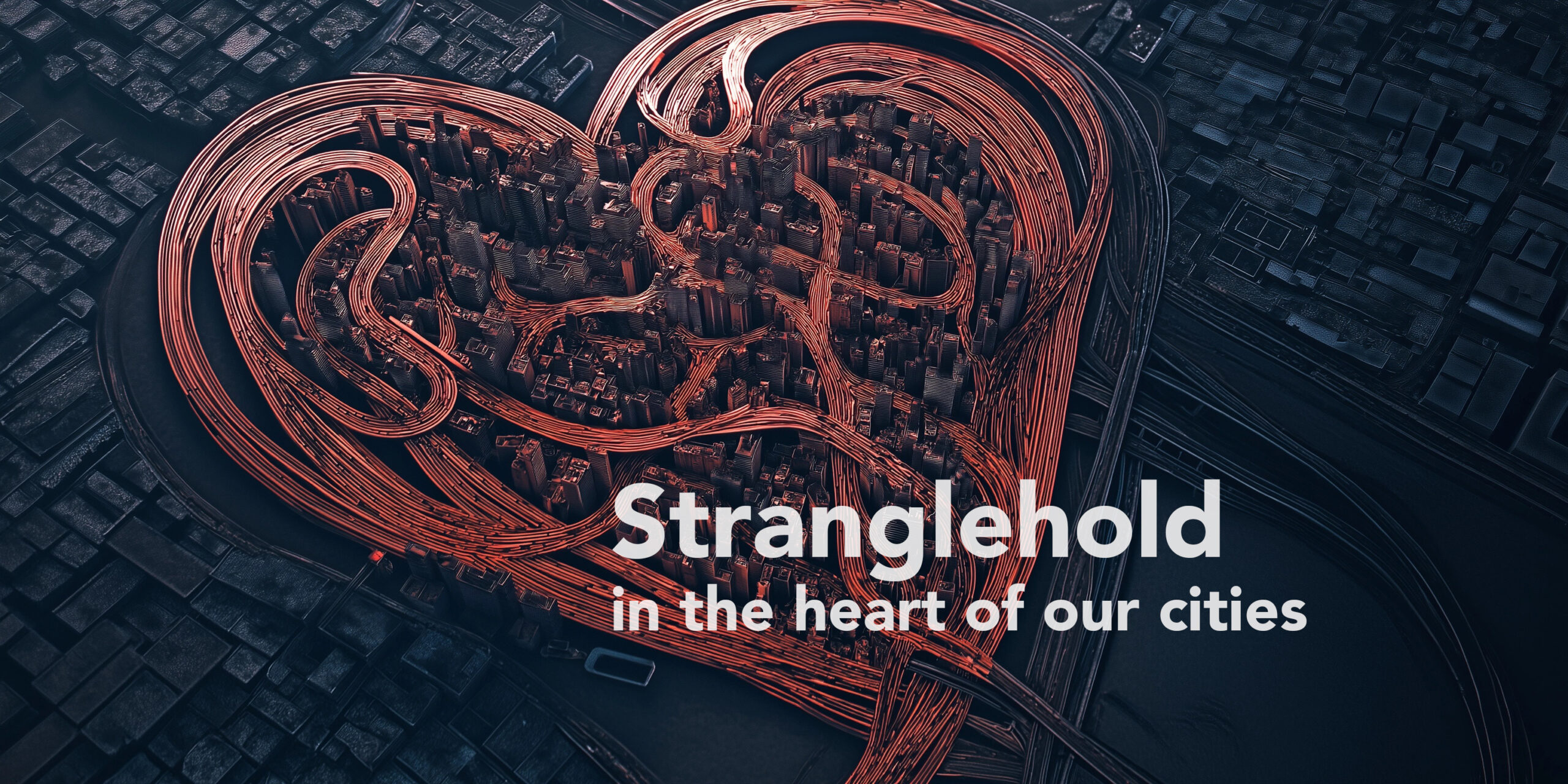
If Modern Cities Were the Hearts of Our Nation...
...Then We Would Be Experiencing Mass Cardiac Arrest Twice Daily
Daily urban congestion is a profound, systemic failure that goes far beyond just “too many cars.” American cities are locked in a cycle of congestion due to a mix of outdated policy, political inertia, auto-centric design, underfunded public transit, and fragmented regional planning. Let me give you a quick breakdown of why this crisis persists just to get the conversation started. I may be wrong, but let’s start formulating a few questions based on these observations:
THE SYSTEM IS DESIGNED FOR CARS, NOT PEOPLE
Post-World War II urban planning in the United States heavily prioritized automobile travel. Highways were constructed through neighborhoods, leading to suburban sprawl and a decline in public transit systems. This design necessitates car usage for basic mobility, resulting in increased traffic congestion.
DEPARTMENTS OF TRANSPORTATION FOCUS ON THROUGHPUT, NOT LIVABILITY
Departments of Transportation (DOTs) have historically aimed to maximize vehicle movement rather than enhance livability. This focus on expanding highways often leads to induced demand, where increasing road capacity results in more vehicles on the road, ultimately exacerbating congestion. For example, despite significant investments in highway expansion, cities like Houston have seen continued congestion due to induced demand.
UNDERINVESTMENT IN TRANSIT AND ALTERNATIVES
Public transit systems in many U.S. cities are underfunded and unreliable. For instance, in 2018, traffic congestion caused Americans to avoid 47.5 million road trips, resulting in nearly $30 billion in lost travel spending—enough to support 248,000 American jobs. This underinvestment limits viable alternatives to driving, especially for working-class commuters.
REGIONAL FRAGMENTATION
Urban areas often span multiple jurisdictions with poor coordination, leading to fragmented transportation planning. For example, in 2024, Seattle was ranked as the 10th most congested city in the U.S., with drivers losing an average of 63 hours to traffic. This increase in congestion is attributed to more employees returning to in-person work and highlights the challenges of coordinating regional transportation strategies.
POLITICAL SHORT-TERMISM
Addressing traffic congestion requires long-term investments and sometimes unpopular decisions, such as implementing congestion pricing. New York City introduced a $9 congestion charge for vehicles entering busy areas of Manhattan, aiming to reduce traffic and fund local transit. Early results showed a decrease in vehicles entering the congestion zone and improvements in travel times. However, such measures often face political resistance due to their immediate impact on constituents.
REAL ESTATE AND AUTOMOTIVE LOBBYING
Powerful interests, including developers and automakers, have historically profited from car dependency. Their influence often sidelines more sustainable, human-centered mobility policies. For instance, in 2018, traffic congestion cost the U.S. economy nearly $87 billion, with drivers losing an average of 97 hours and $1,348 each due to congestion. Despite these substantial economic losses, lobbying efforts have often prioritized road expansion over investment in public transit solutions.
LACK OF IMAGINATION AND COURAGE
Many leaders treat congestion as an inevitable nuisance instead of a solvable design failure. Cities that have made progress—like Copenhagen, Seoul, or Bogotá—demonstrate the potential of vision and bold policy shifts. In the U.S., however, such transformative approaches are often lacking. For example, in 2018, the average Boston driver lost 164 hours to congestion, costing the local economy $4.1 billion. These figures underscore the urgent need for innovative solutions to urban traffic woes.
Traffic congestion is more than a nuisance—it’s a daily psychological and economic assault. It costs billions in lost productivity, worsens air quality, deepens inequality, and, as you said, wears down the soul. We need a complete paradigm shift.
So, let’s begin by asking some tough questions, holding politicians accountable, and conducting poignant cost-benefit analyses that begin to underscore and highlight the real daily toll.

A New Path Forward: Solutions from Alfa8
At alfa8, we believe in turning crisis into opportunity. We leverage artificial intelligence, large language models (LLMs), and parametric design to develop asymmetric strategies that dive deep into cost-benefit analysis and generate out-of-the-box solutions for relieving urban congestion.
Our unique blend of strategic design consultancy and leading-edge mobility technologies enables us to deliver holistic and actionable strategies that don’t just treat the symptoms, but ask the hard questions at the root of the problem. From system-wide mobility audits to advanced simulation modeling, we craft roadmaps that cities and institutions can follow toward real, measurable impact.
This age-old pandemic—this hemorrhaging of our cities, values, and lives—demands more than incremental tweaks. It requires bold reimagination. Alfa8 brings together pioneering technologists, advanced research institutions, visionary planners, and infrastructure experts under one integrated framework to design for the future, today.