
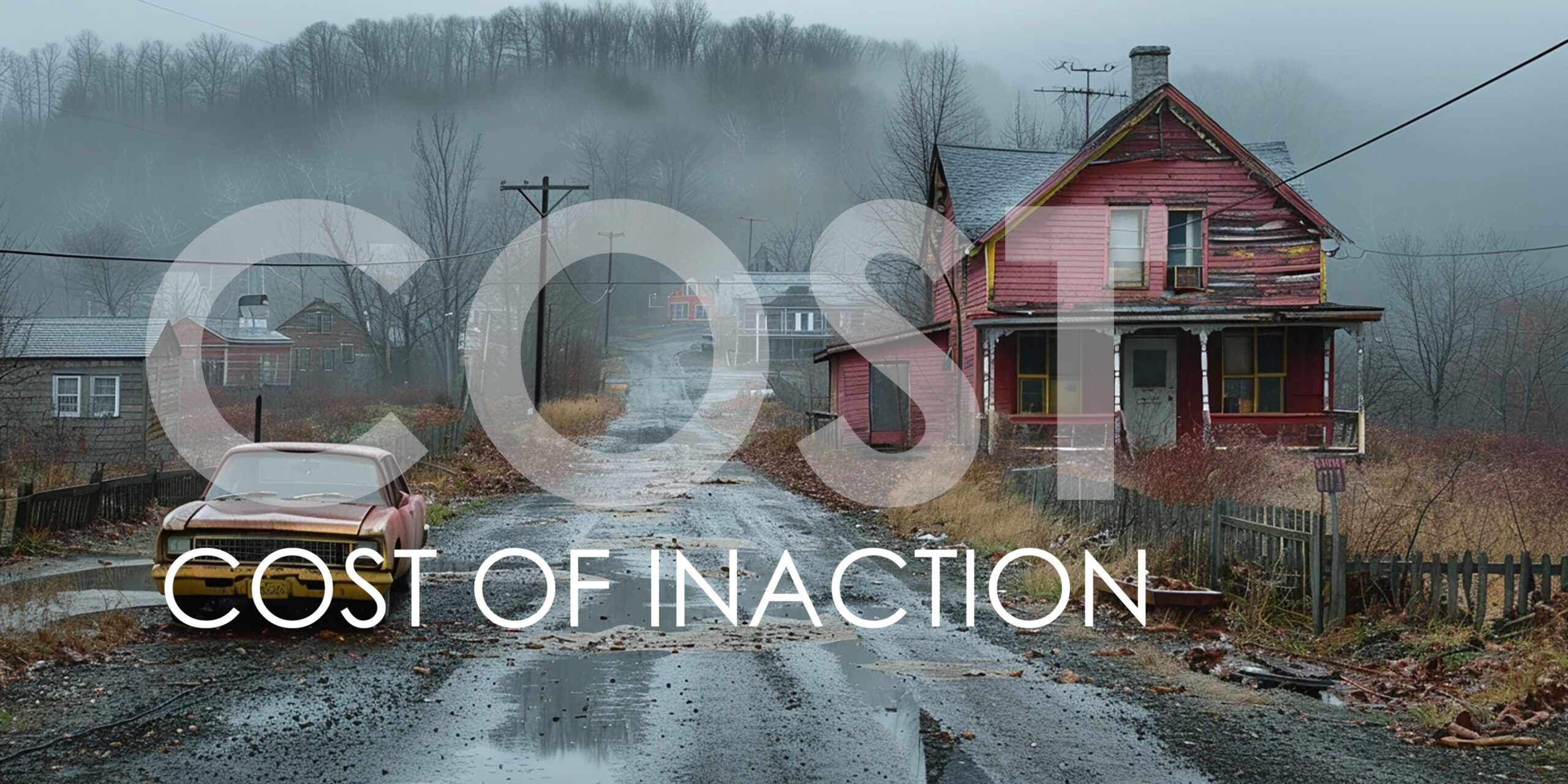
In the face of both sudden catastrophes and chronic societal challenges, the repercussions of inaction are painfully severe and far-reaching, often hidden, and frequently not addressed until such time it is too late. Let’s take a moment to macroscopically review the economic and social costs associated with our inadequate and hubris-laden responses to acute disasters—such as hurricanes, earthquakes, and wildfires—as well as chronic systemic failures in transportation, mental health, housing, and healthcare. Through a simple cost-benefit analysis, we can quickly highlight the staggering economic toll of inefficiency and inaction. And consequently, perhaps we can learn to start advocating for proactive, systemic solutions to enhance resilience and societal well-being. We certainly have the tools and technology to do so.
To a certain extent, this is not new information. We are all very much aware of the cost of inaction. We have all paid the price to a large or small extent. So why aren’t we doing something about it? I am reminded here about Yuval Noah Harari’s book, Nexus, where he questions whether there is a genetic deformity baked-in our system that predisposes us toward making destructive choices, and not heeding the so-called Black Elephant in the room. We are thus plagued by the Black Swans that swim in the lake of endless hubris and denial.
Below we’ve done some light research to assemble a few placeholder numbers and to start the discussion and engender ideas for exploration in this space. Of course, you are most welcome to send us your papers and research if so inspired. We’d be delighted to engage.
High Cost of Reactive Disaster Response
Acute disasters demand immediate, coordinated responses. However, U.S. disaster management remains riddled with inefficiencies that amplify losses.
Economic Toll of Natural Disasters
Between 1980 and 2023, the U.S. experienced 376 weather and climate disasters, each causing over $1 billion in damages, totaling over $2.7 trillion in economic losses.
- Hurricane Katrina (2005): $125 billion in damages; FEMA’s response was slow and inefficient, leaving thousands stranded without adequate aid. More Information…
- Hurricane Maria (2017): $90 billion in damages; Puerto Rico endured a prolonged humanitarian crisis due to logistical failures and bureaucratic delays. More Information…
- California Wildfires (2018-2022): Over $100 billion in damages annually; response costs are exacerbated by delayed funding and inefficient resource distribution. More Information…
- California Wildfires (2025): Longterm economic loss is still being assessed. More Information…
Cost of FEMA’s Bureaucratic Inefficiencies
FEMA’s disaster relief programs are plagued by slow deployment and excessive administrative costs. By certain Government Accountability Office (GAO) reports up to 50% of FEMA’s disaster relief funding is consumed by administrative overhead before reaching affected communities.
- Example: For every $10 billion allocated to disaster relief, only $5 billion directly benefits victims.
- Solution: Streamlining emergency response supply chains, decentralizing response teams, and leveraging AI for disaster forecasting could cut administrative costs by 30%, freeing up $3 billion annually for direct aid.
Chronic Stressors: The Hidden Drain on the Economy
But while acute disasters capture our attention and garner our immediate visceral sympathies, beyond acute disasters, systemic inefficiencies silently erode economic and social stability. Addressing these chronic stressors requires recognizing their compounded costs.
Transportation Inefficiencies: The Daily Bleed
Traffic congestion and inefficient transportation systems impose severe economic burdens. These numbers are highly conservative estimates, but certainly require a deeper dive and study, leverage layered data to explore the cascade of impact that ensues from subjecting populations to traffic, beyond congestion, to patterns of labor flow, productivity, and even health dynamics:
- Annual cost of traffic congestion in the U.S.: $87 billion in lost productivity and fuel costs.
- Commuters lose an average of 54 hours per year due to congestion, costing an estimated $2,000 per driver annually.
- Vehicle wear and tear costs: $2,000 per year per driver due to excessive braking and stop-and-go traffic.
- Productive toll aggregates, and lost labor.
- Health and wellness…
Solution: Investing in smart infrastructure, AI-driven traffic management, and public transit expansions could cut congestion costs by $30 billion annually. But that’s just the tip of the iceberg.
Investing in edge cities and horizontal and distributed development, activation of rural communities, proactive hybrid solutions, and bold multimodal transit concepts are but a few options. Scalable and dynamic design strategies are required urgently as part of new infrastructure development.

The Silent Pandemic: Mental Health Crisis
Mental health disorders impose severe economic costs on both individuals and the nation. There are once again known and visible numbers. This is what’s visible. The spectrum of mental health and wellness extends to systems and corporations and intangible shades of grey that define blurred boundaries of society.
- Annual cost of untreated mental illness in the U.S.: $280 billion (lost productivity, ER visits, and social services).
- Suicide rates have risen 35% since 2000, with depression alone costing businesses $44 billion annually in absenteeism and lost productivity.
This is truly where a journey of a thousand miles begins with the first step. But we must start and do so holistically. Expanding mental health access and integrating AI-driven early intervention could reduce economic burdens by $100 billion annually. Educating the various stakeholders, integrating the insurance companies and care providers into an intelligent and collaborative ecosystem, and addressing and embracing the crisis on a social basis is the beginning of the journey. Leadership backed by science and data is critically needed to shape cultural awareness and form effective policy in this space.
Housing Instability: The Cost of Poor Planning
The lack of affordable housing fuels homelessness and economic stagnation. IT’s profoundly alarming that we have not been able to address this in 2025. Through some vague specter of cognitive dissonance, we have come to accept homelessness, and housing inequity as a normative condition. Here are some snippets of data we could find to tease the argument. But the actual numbers are alarming, and as per above, it is the hidden layers and the web of impact that should deeply concern us.
Unfortunately, these are simple solutions that could be addressed with proper planning and foresight. Yet we are indeed deeply fragmented to be able to get our heads around the solution. Now add to this the increased forced migration due to the growing array of stressors emerging over the horizon.
- Estimated economic impact of homelessness: $7 billion annually (healthcare, emergency services, and lost productivity).
- Average cost to taxpayers per homeless individual: $35,000 per year (ER visits, policing, and shelters).
- Homeownership rate decline: Over the past two decades, homeownership has dropped from 69% to 63%, forcing more families into rental markets where they spend 50% of their income on housing.
Reform in housing policy is a good place to start. Opening and addressing new urban planning and zoning requirements, expanding and developing edge and satellite communities that can accommodate affordable housing, fostering and supporting private investment vehicles, are all some ideas. A $50 billion federal investment in affordable housing construction could yield a $200 billion economic return over 10 years by reducing homelessness and boosting consumer spending. Let’s begin to ask bold disruptive questions, look at the data that underlies these metrics and policies and create new paradigms.
The Healthcare System’s Fragmentation
The inefficiencies in the U.S. healthcare system are daunting and have driven up costs and created disparities in care. The health business system in the US has become brutally and prohibitive, in many instances unintentionally. But, nevertheless… One of the most frightening and debilitating burdens has become the administrative quagmire that has hemorrhaged the industry, and more importantly, the lives of the citizens. Beyond a cursory look at conservative numbers, the toll on the quality of lives is unimaginable. This must be addressed. It can be addressed. The garden-walled fortresses in this fragmented kingdom must come down, and reintroduce care in the health business:
- Administrative waste in U.S. healthcare: $265 billion annually.
- Uninsured patients cost hospitals: $42 billion annually in uncompensated care.
- Pharmaceutical price markups: The U.S. pays 2.5x more for prescription drugs compared to other high-income countries.
Implementing value-based care models and streamlining administrative processes could save more than $150 billion per year, reducing costs for patients and providers. Wouldn’t that be nice? But as the case above, that’s just the start. Just imagine for a moment the positive impact of an efficient and well-coordinated care system on speed of access to care and proactive wellness resources, and its soft and indirect impact on the community and the nation.
Making the Case for Proactive Reform
And so, the cost of inaction is staggering. It requires a much deeper exploration than this press to truly understand the depths of the cost of inaction. But let’s begin with some light, quick brainstorming, shall we? What if we start transitioning to proactive, data-driven solutions, that could save the United States over $500 billion annually (again, this is simply a placeholder number. I forecast that when we are truly done, the actual cost will be devastatingly more that this amount) across disaster response, transportation, mental health, housing, and healthcare.
Problem | Current Annual Cost | Potential Savings from Reform |
Disaster Response Failures | $50B+ | $15B (streamlined FEMA operations) |
Traffic Congestion | $87B | $30B (smart infrastructure) |
Mental Health Crisis | $280B | $100B (expanded access) |
Housing Instability | $7B | $20B (affordable housing investment) |
Healthcare System Waste | $265B | $150B (administrative efficiency) |
Total Cost of Inaction | $689B | $315B in savings |
Key Policy Recommendations
Integrate and innovate, leverage data-driven and AI solutions to garner deeper and actionable intelligence. Some placeholder solutions derived from and supported by data can be along these lines:
- Disaster Preparedness Investments: Allocate $10 billion annually to pre-disaster mitigation, cutting future relief costs by $20 billion.
- AI-Driven Traffic Management: Invest $5 billion in adaptive traffic control systems, reducing commute times and fuel waste.
- Universal Mental Health Coverage: Expand coverage under Medicaid and employer programs, saving $100 billion in lost productivity.
- Affordable Housing Expansion: Direct $50 billion into affordable housing projects, with long-term returns of 4x investment.
- Healthcare System Reform: Reduce administrative waste through AI automation, yielding $150 billion in annual savings.
The Cost of Inaction is Unacceptable
At the end of the day, numbers speak loudest, and the numbers written above speak for themselves, albeit they are just a sliver of the cost profile: America is hemorrhaging hundreds of billions of dollars annually due to systemic inefficiencies. These are not abstract losses—they manifest in wasted lives, economic stagnation, and missed opportunities for national resilience.
And so, it is urgently underscored that by shifting from a reactive to a proactive model—investing in disaster preparedness, infrastructure, healthcare reform, and housing—the U.S. can not only save over $300 billion+ annually, but improve quality of life, and build a more resilient society that can become the backbone and foundation of American prosperity.
The time for action is now. The cost of inaction is no longer just a price tag—it’s a threat to national stability and prosperity. And this Cost is the core reason we have moved forward toward developing the rSL (reSource Lab) as an epicenter of exploring the art of the possible and asking bold questions in the public square. We look forward to more voices taking the lead and joining in this conversation with us and elsewhere.
-Iliad Terra, CEO of alfa8